Route · Chennai → Kanchipuram
Chennai to Kanchipuram by Force Urbania
75 km · 2 – 2.5 hours · 13 Seater recommended
Chennai → Kanchipuram · indicative rates
Fares shown are indicative starting rates. The final charge is based on real-time usage — distance, hours or days, tolls, parking and permits. Outstation trips are charged on a minimum of 300 km per day. Driver batta is ₹1,000 per day; late-night batta of ₹1,000 applies between 22:00–05:59. GST at 5% applies to the total.
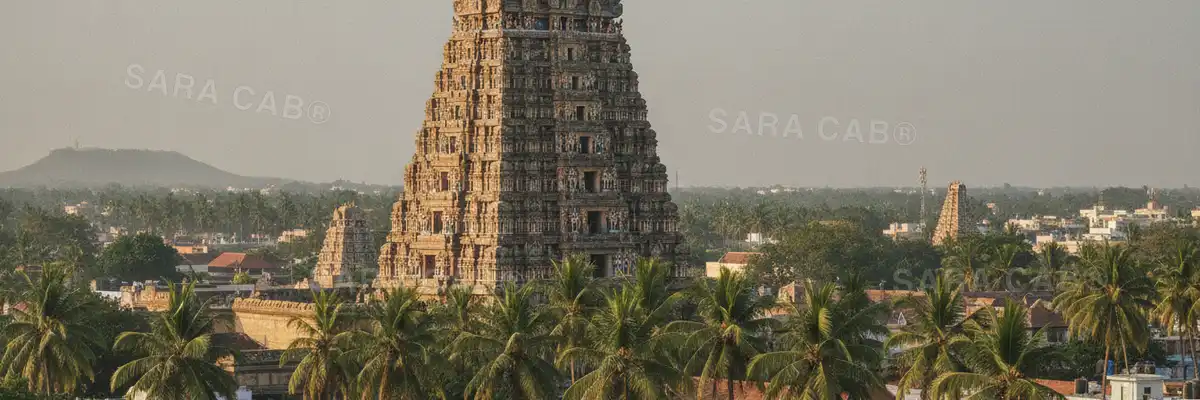
A gopuram rising above the rooftops — the shape that gives Kanchipuram its skyline. The town has been a temple centre for well over a thousand years and the major shrines sit some distance apart, which is why this is a trip that needs a vehicle waiting rather than one you walk between.
Quick facts
| Distance | Approximately 75 km each way |
|---|---|
| Drive time | 2 – 2.5 hours, traffic permitting |
| Recommended seater | 13 Seater (12+D) |
| Passengers | Up to 12 in the recommended vehicle |
| Luggage | Not a factor on a day trip; travel light for temple visits |
| Terrain | Flat highway inland from Chennai via Sriperumbudur |
| Ghat sections | |
| State crossings | None — stays within one state |
| Permits | No interstate permit — the route stays within Tamil Nadu. |
| One-way | Available |
| Round trip | Available |
| Driver batta | ₹1,000 per day; ₹1,000 late-night (22:00–05:59) |
| Recommended departure | Before 06:30. Most temples here close for several hours around midday, so the morning is the whole trip. |
Distance and drive time are indicative planning figures, not the basis of a quote. Fares are calculated on actual usage — see the rates below.
Why an Urbania for this route
Kanchipuram is close enough to Chennai to look like a half-day and structured enough to need a full one. The drive is seventy-five kilometres of flat highway and takes a little over two hours. What decides the day is that the major temples are spread across the town rather than clustered, and that most of them close for several hours around the middle of the day.
That midday closing is the single most useful thing to plan around. A group that leaves Chennai at nine arrives to find its second temple shut and spends the afternoon waiting. A group that leaves at half past six covers three or four properly before the closing, uses the gap for lunch and the silk weavers, and picks up again in the late afternoon. Same trip, entirely different day.
Having your own vehicle is what makes the spread manageable. Ekambareswarar, Kamakshi Amman, Varadaraja Perumal and Kailasanathar are each a drive apart, and moving twelve people between them by auto is slow and needs renegotiating at every stop. The chauffeur holds, waits and moves you on when you are ready.
Which Urbania should you choose?
The 13 seater is our usual choice. The roads out are wide and flat so the 17 drives easily, but Kanchipuram's temple streets are narrow and congested and the shorter vehicle gets meaningfully closer to each entrance. On a day where you stop four or five times, that difference adds up.
Luggage is not a consideration on a day trip. If Kanchipuram is a stop on a longer temple circuit towards Tiruvannamalai or Kumbakonam, size up for the bags rather than for the town.
Suggested itinerary
- Sriperumbudur — On the highway out of Chennai, with room for a long vehicle to stop.
- Kanchipuram — The temple town itself. The major temples are spread across it rather than clustered.
- Silk weaving centres — On the edge of town, and the reason many groups add an afternoon.
Itineraries are indicative. Actual routing, timings and stops are subject to road, weather, traffic and permit conditions, and to the chauffeur's judgement on ghat sections.
Road notes
Straightforward flat highway with no ghat sections. The driving is easy; the difficulty is entirely inside the town, where the streets around the temples are narrow, congested and effectively one-way in practice regardless of the signage.
Season
October to February is comfortable. April to June is hot and the temple courtyards are stone underfoot, which matters more than the air temperature. Festival days transform the town — crowds swell and the streets around the major temples close to vehicles entirely.
Getting around at Kanchipuram
Keep the vehicle for the whole day — releasing it here makes no sense, since the temples are the trip and they are spread out. Expect a short walk at each: the streets immediately around the major shrines are narrow and busy, and a seven-metre vehicle cannot get to the door.
The silk weaving cooperatives on the edge of town are the natural afternoon, and they fit neatly into the midday temple closing. They are also easier to reach with a vehicle waiting than most people expect, being outside the congested centre.
Worth seeing
- Ekambareswarar temple
- Kamakshi Amman temple
- Varadaraja Perumal temple
- Kailasanathar temple
- Silk weaving cooperatives
Parking
Streets around the major temples are narrow and busy. The chauffeur drops at the nearest workable point and holds in a designated area — expect a short walk at each temple.
Rates
| Seater | Configuration | From, per km | Driver batta / day | Minimum / day |
|---|---|---|---|---|
| 10 Seater | 9+D — up to 9 passengers | ₹38 | ₹1,000 | 300 km |
| 13 Seater | 12+D — up to 12 passengers | ₹42 | ₹1,000 | 300 km |
| 17 Seater | 16+D — up to 16 passengers | ₹45 | ₹1,000 | 300 km |
Fares shown are indicative starting rates. The final charge is based on real-time usage — distance, hours or days, tolls, parking and permits. Outstation trips are charged on a minimum of 300 km per day. Driver batta is ₹1,000 per day; late-night batta of ₹1,000 applies between 22:00–05:59. GST at 5% applies to the total.
Questions about this route
How long does Chennai to Kanchipuram take?
Seventy-five kilometres and a little over two hours on flat highway, assuming a reasonable start. The road is easy throughout; the time you lose is in Chennai's own traffic if you leave late.
What time should we leave Chennai?
Before half past six. Most temples in Kanchipuram close for several hours around midday, so an early start is not about beating traffic — it is about how many temples you actually get inside. Leaving at nine typically costs you two of them.
How many temples can we see in a day?
Three or four properly, if you start early and accept the midday closing. Attempting all the major ones in a single day produces a group that has seen a lot of gopurams from the outside. We would rather plan four well than seven badly.
Can the vehicle reach the temple entrances?
Not usually. The streets around the major shrines are narrow, crowded and effectively one-way regardless of the signage. The chauffeur drops at the nearest workable point and holds in a designated area, so expect a short walk at each temple.
Do we need a permit?
No. The route stays within Tamil Nadu throughout, so no interstate permit applies. Tolls on the Bengaluru highway as far as the Kanchipuram turn are charged at actuals against receipts.
Is it worth combining with the silk weavers?
It fits the day well, because the weaving cooperatives are open through the midday hours when the temples are not. They sit on the edge of town rather than in the congested centre, so the vehicle can get close.
How much walking is involved?
More than people expect — a short walk to each temple from where the vehicle can stop, then a good deal of walking inside large complexes, on stone that is hot underfoot in the afternoon. Tell us if anyone in the group has difficulty walking; it changes which temples we would suggest.
What happens on festival days?
The town transforms. Crowds swell, and the streets around the major temples close to vehicles entirely, which pushes the drop point much further out. It is still a good day, just a different one. Check the calendar before fixing a date, and tell us so we can plan the drop.
Can we combine Kanchipuram with Tiruvannamalai?
Yes, and it makes a natural two-day temple circuit from Chennai rather than two separate day trips. What does not work is both in one day — you would arrive at Tiruvannamalai with the light going and the temple about to close.
Which seater should we take?
The 13 seater for most groups. The highway suits any of the three, but the narrow temple streets favour the shorter vehicle, and on a day with four or five stops that difference is felt every time.
What is the best time of year?
October to February. April to June is hot, and it matters more here than the air temperature suggests because temple courtyards are stone underfoot and you walk them barefoot.
Is this a good trip for a mixed group?
It is, provided the walking is planned for. The drive is short and easy, there is no climb or altitude, and the day has natural breaks built into it by the midday closing. It is the temple circuit we would suggest first for a group with older relatives.
More from Chennai
Other trips out of Chennai
Chennai to Tirupati
135 km · 3 – 3.5 hours
Chennai to Pondicherry
150 km · 3 – 3.5 hours
Chennai to Mahabalipuram
58 km · 1.5 – 2 hours
Chennai to Tiruvannamalai
195 km · 4 – 4.5 hours
Chennai to Kodaikanal
520 km · 9 – 10 hours
Chennai to Yercaud
360 km · 6 – 6.5 hours
Chennai to Velankanni
330 km · 6 – 6.5 hours
Chennai to Vellore
140 km · 2.5 – 3 hours
Also popular from Chennai
- Rameswaram
We run these regularly and quote them on the phone. A route only gets a page once we have verified detail to put on it.
Plan this trip
- About Kanchipuram
- All Urbania hire in Chennai
- 13 Seater — the seater we suggest
- Compare all seaters
- Full tariff
Route information last verified 2026-09-02.