Destination · Tungabhadra valley, Deccan
Hampi
Karnataka · around 470 m · Two nights minimum; three to add Anegundi across the river.
About Hampi
Vijayanagara ruled most of southern India for two centuries and its capital here was, by the accounts of Portuguese and Persian visitors, among the largest and richest cities in the world. In 1565 a coalition of Deccan sultanates destroyed it over several months. What stands today is not a ruin that decayed but a city that was deliberately unmade, which is why so much survives and so little of it is whole.
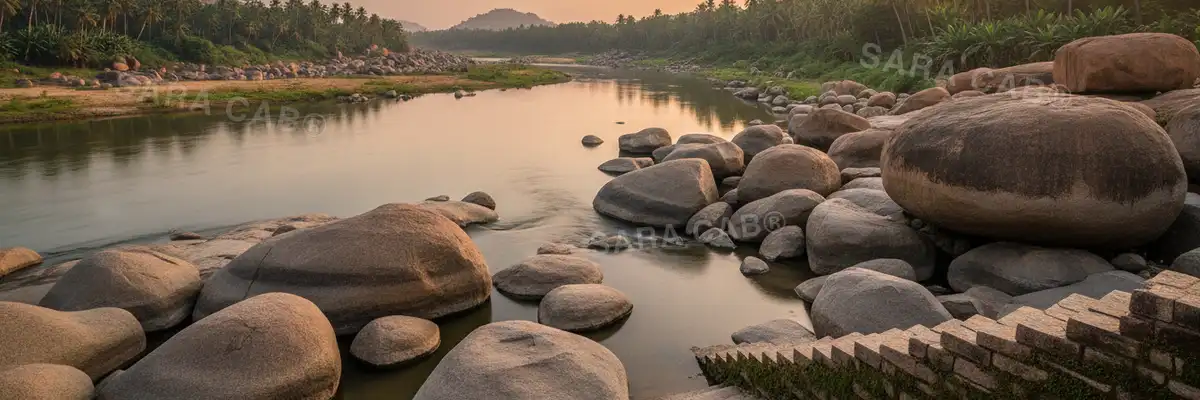
The setting is as strange as the history. The Tungabhadra valley is filled with granite boulders the size of houses, stacked and balanced as though tipped there, and the builders worked with them rather than clearing them — temples wrap around outcrops and stairways run between them. Local tradition identifies the landscape with Kishkindha of the Ramayana, and standing in it that is easy to believe.
What to look for varies with what interests you. The Vittala temple's stone chariot is the image on the currency note; its musical pillars are the thing people remember. The royal enclosure shows the water engineering that sustained a city of half a million in semi-arid country. The Virupaksha temple has been in continuous worship for over 700 years and is still a working shrine rather than a monument.
Staying there
Hospet, about 13 km from the ruins, has the widest choice and the easiest access. The Hampi bazaar side is closer and quieter with narrower lanes, and Anegundi across the river is quieter again and increasingly where people stay a third night.
Hampi is a protected site and the bazaar area has been substantially cleared, so accommodation immediately beside the monuments is limited by design rather than by demand. Plan on staying a short drive away.
Worth your time
- Virupaksha temple
- Vittala temple and the stone chariot
- Hampi bazaar
- Matanga Hill
- Lotus Mahal and the Zenana enclosure
- Anegundi across the river
| Region | Tungabhadra valley, Deccan, Karnataka |
|---|---|
| Altitude | Around 470 m |
| Best season | October to February only, realistically. March to June is genuinely unwise rather than merely hot. |
| Suggested stay | Two nights minimum; three to add Anegundi across the river. |
Getting there
Routes to Hampi
Each route guide covers the real drive time, which seater we would send, the itinerary, permits and the questions people actually ask about that approach.
Multi-day
Circuits including Hampi
What it costs
| Seater | Configuration | From, per km | Driver batta / day | Minimum / day |
|---|---|---|---|---|
| 10 Seater | 9+D — up to 9 passengers | ₹38 | ₹1,000 | 300 km |
| 13 Seater | 12+D — up to 12 passengers | ₹42 | ₹1,000 | 300 km |
| 17 Seater | 16+D — up to 16 passengers | ₹45 | ₹1,000 | 300 km |
Fares shown are indicative starting rates. The final charge is based on real-time usage — distance, hours or days, tolls, parking and permits. Outstation trips are charged on a minimum of 300 km per day. Driver batta is ₹1,000 per day; late-night batta of ₹1,000 applies between 22:00–05:59. GST at 5% applies to the total.
Questions about Hampi
How long do we need at Hampi?
Two nights minimum given the drive at each end. One full day covers the main clusters at a reasonable pace; three nights lets you add Anegundi across the river and see it without rushing.
When should we not visit?
March to June. Hampi is open rock with almost no shade and a full day there in April is genuinely unwise rather than just uncomfortable. October to February is the answer and we will say so rather than take a summer booking.
Which parts should we prioritise?
The Vittala temple for the stone chariot and the musical pillars, the royal enclosure for the water engineering, and Virupaksha, which has been in continuous worship for over 700 years. If you only have half a day, those three.
Where should we stay?
Hospet for choice and easy access, about 13 km out. The Hampi bazaar side is closer and quieter with narrower lanes; Anegundi across the river is quieter again. Send us the property name if you are not at Hospet.
What actually happened in 1565?
A coalition of Deccan sultanates defeated Vijayanagara at Talikota and then spent several months destroying the capital. It was never reoccupied. That is why the site is so extensive and so little of it is intact — this is a city that was unmade rather than one that decayed.
Is a guide worth it?
Genuinely yes, and we say that as the transport rather than as anyone with an interest. The site is dense with detail that is invisible without one. We do not arrange guides or take a commission — engage one there.
Why are the boulders like that?
The valley is one of the oldest exposed rock surfaces on earth, weathered into stacked granite outcrops. The Vijayanagara builders worked with them rather than clearing them — temples wrap around outcrops and stairways run between them, which is what makes the site look unlike anywhere else in India.
Is Anegundi worth crossing for?
On a third night, yes. It is the older settlement across the river, quieter than Hampi itself and associated with the Kishkindha of the Ramayana. Increasingly it is where people stay rather than just visit.
Can we combine Hampi with Badami?
Yes, and it is the natural extension — Badami, Pattadakal and Aihole are a few hours further north. Our Karnataka Heritage Trail does exactly that over six days and is a better use of the long drive north.
Is the coracle crossing worth doing?
Most groups enjoy it, and it takes you to the Anegundi side. It depends on the river level and is not always running. We cannot book it and would not build a day around it — treat it as a bonus.
Destination information last verified 2026-09-02.